Showing posts with label urban beekeeping. Show all posts

Saturday, 17 January 2015

A good year for honey

I've heard from both commercial beekeepers and hobbyists that this season has been a good one in terms of honey production.

Based on the output from our hive I'd have to agree.  Last night we bottled the honey that was extracted recently. Usually we only harvest once, doing a whole box at a time. This season we should be able to harvest a couple of times.  The honey below came from a single full-sized box:


The large jars on the left hold over 500ml.  All up it was nearly 17 litres of honey.

Our stash of recycled jars is now empty. Looks like we're going to have to enlist the help of friends to collect some more for the next harvest.


Monday, 20 October 2014

Do the shake


We're doing the shake....................the sugar shake, that is.

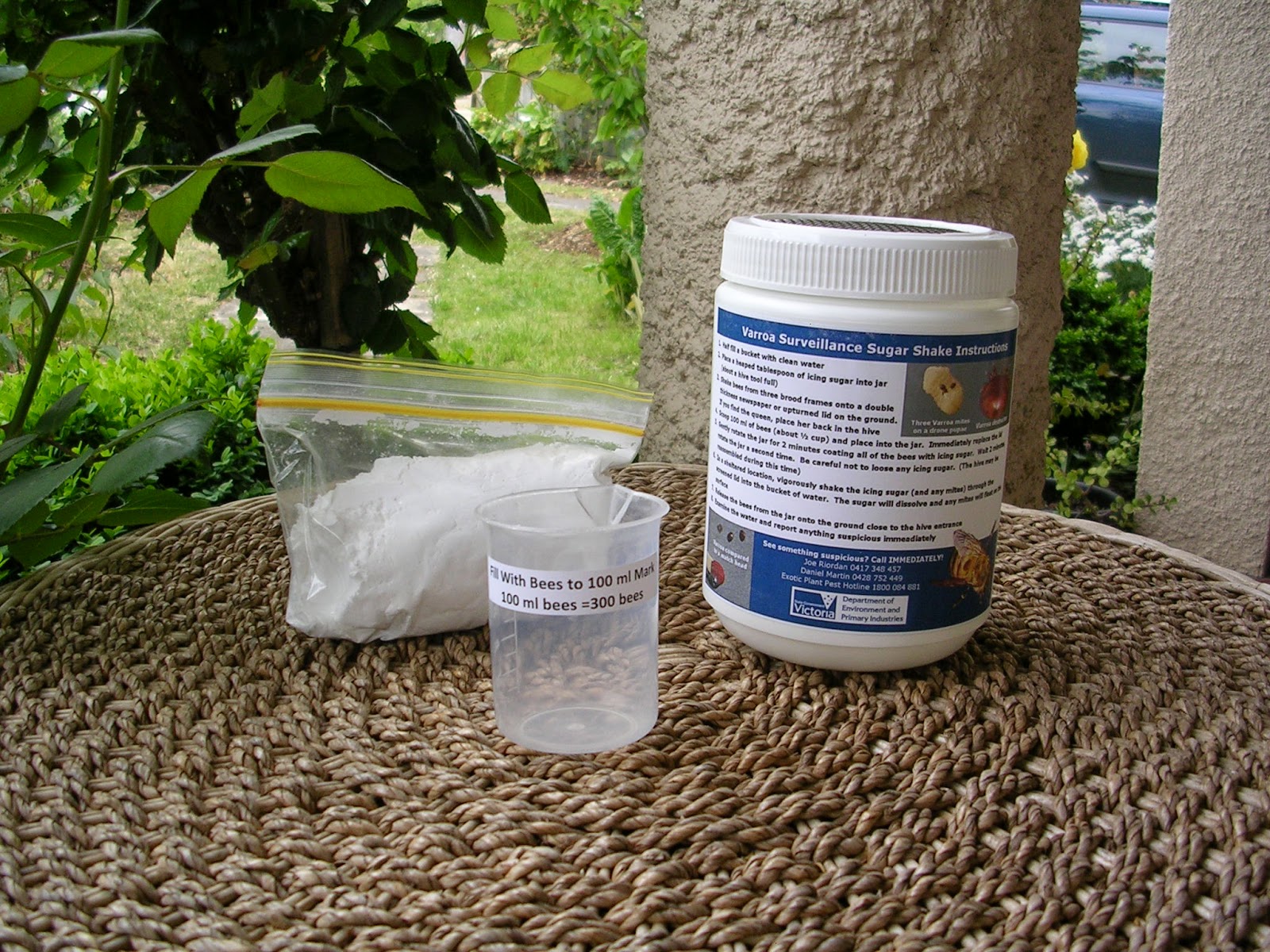
DEPI Varroa surveillance sugar shake kit
  
As you may be aware, Australia is the only country that does not have the dreaded varroa mite and we're trying to keep it that way. The Department of Environment and Primary Industries (DEPI) is running several surveillance programs for early detection of an incursion of varroa at, and near, shipping ports.  At a recent bee club meeting, Daniel Martin, the DEPI Apiary Inspector from Bendigo gave us a presentation on the department's programs.
 
In addition to the port surveillance programs, DEPI also runs a sugar shake detection program. This is where we urban beekeepers can do our bit to help with varroa detection. The program encourages beekeepers to test their own hives for varroa using the simple sugar shake (or roll) test. This test works as follows - when varroa mites are dusted with pure icing sugar, the fine granules stick to their pads (feet) and they are no longer able to grip the surface on which they cling. The dusting of adult bees with icing sugar causes mites to fall off the bee into the white sugar where they are more easily seen. This process does not harm the bees.

Beekeepers who volunteer to join the DEPI sugar shake program receive a kit, along with a letter explaining the requirements of the program.  Participants will receive 3 requests from DEPI during the year to test their hives using the equipment supplied.  It seemed like a good thing to do so we signed up.  A few weeks later the kit came in the mail. 

The kit consisted of:
  • a 500g plastic container with a screw-top mesh lid. Instructions on how to perform the test were stuck to the side of the container.


  • a 100 ml plastic measuring vessel


  • a bag of pure icing sugar


In addition to the supplied kit, the following equipment is also required:
  • tablespoon for measuring icing sugar
  • sheets of newspaper
  • light coloured bucket (white or other light colour)
  • fine close-weaved household cleaning cloth or coffee filter paper
  • bee smoker, hive tool and protective clothing
  • magnifying lens (if available)
  • water-proof felt marking pen.

The actual test and reporting proces is described below. This information and the  accompanying photos have been taken from the DEPI website. Check out the website for further information on varroa and beekeeping in general.

Method

  • half fill the bucket with clean water
  • place a heaped tablespoon of icing sugar into the jar after removing lid
  • light a smoker and open a hive to be tested
  • shake some bees from three combs containing honey bee brood onto a double thickness of newspaper or upturned hive lid placed on the ground. If brood is not present, shake bees from one comb taken from the centre of the cluster of bees. If you find the queen on these combs, place her back into the hive
  • scoop or pour about 300 bees (half a cup) into the jar. Place the lid on the jar to prevent bees from escaping
  • gently rotate the jar for 2 minutes ensuring all bees are dusted with sugar. Wait 2-3 minutes, and rotate the jar a second time for 2 minutes. Be careful not to lose any sugar. (The hive may be reassembled during this waiting period)
  • gently shake the icing sugar (and any mites) through the holes in the lid into the bucket half filled with water. The sugar will dissolve and any mites will float on the surface of the water. Do the shaking in a sheltered position protected from strong wind that could blow mites away
  • release the bees from the jar onto the ground close to the hive entrance in case the queen is present.

Photo 2. Shake some bees from 3 combs on to newspaper

Photo 3. Pour about half a cup of bees into the jar

Looking for varroa and collection of specimens

Photo 4. Gently shake the sugar into the bucket containing water

  • examine the empty shaker jar and lid for varroa. If you wear glasses to read, wear them while looking for varroa. The mites are reddish-brown; 1.1 mm long and 1.7 mm broad
  • inspect the water surface for varroa, other mites and insects. If you find any, carefully place them into a small jar with methylated spirits and place the jar in a cool position away from sunlight
  • alternatively, pour the water through a piece of light coloured fine close-weaved household cleaning cloth, or coffee filter paper. Inspect the cloth or filter paper for varroa, other mites and insects. If any of these are present or suspected to be present, place and seal the filter cloth or filter paper in a small zip-lock plastic bag or other sealable container
  • use a water-proof pen, label the specimen jar and/or ziplock bag and the hive tested with the same number for later identification.


Steps if you find or suspect presence of varroa in your apiary

It is important that when varroa is found or even suspected to be present in an apiary that it is not spread to another apiary. The following steps will help to reduce the risk of spreading it:
  • don't mail or forward any varroa (and other mites and insects), until advised by a Department of Primary Industries apiary officer. Never take live specimens from the apiary as this may help to spread the parasite or pest
  • don't remove bees or any hive components from this apiary as this could help spread the mite
  • place overalls, veil, gloves (and guantlets) and hat in a plastic bag and leave them at the apiary site until advised by a DPI apiary officer
  • before leaving the apiary, inspect your vehicle to make sure that there are no bees trapped inside or on the radiator. Spray and remove any bees that could be carried from the apiary. Check the tray of the truck, ute or trailer as well. Boxes of combs and other hive material on your vehicle which bees might have entered must be left at the apiary
  • thoroughly wash hands, hive tool, smoker and any other equipment to ensure varroa is not carried from the apiary
  • use a fine toothed comb or brush to remove any mites that may have lodged in hair or beards
  • check clothing for any 'passenger' bees that could be carried by you when leaving the apiary. If another person is with you, have them check your clothing for passenger bees.
 

Notifiable disease

If you see or suspect varroa is present in your apiary, you must notify an Inspector of Livestock (DPI apiary officer, animal health officer or veterinary officer) without delay and by the quickest means possible. The easiest way to do this is to ring the Disease Watch Hotline 1800 675 888 (24 hours a day, every day of the year).

------------------------------------------------------------------------------------------------------------------------

The test instructions seem fairly straightforward. Still, I think it might be a good idea for us to have a practise run before getting the call to do it for real....


Saturday, 18 October 2014

Busy as a .....

Busy as a ............yep, you guessed it.......... bee.

Here are some photos taken in our garden last weekend.

bee on sage


bee on rose geranium


bee visiting a stone fruit tree


a beautiful callistemon flower


Thursday, 25 September 2014

Hive insulation over winter - did it work?

Back in May I mentioned that we were trialling some insulation on our hive over winter. The previous winter we had noticed that there was a fair bit of condensation in the hive - on the top mat and under the lid.  In an attempt to avoid that this year we used some wall insulation sheeting, laid directly on the frames in the top box, as described here.  Now, almost one month into Spring and with the days warming up, it was time to look inside the hive and assess how well the insulation had worked.

When I removed the lid I was pleased to see that the hive mat and insulation sheet were  both dry, as was the underside of the lid.  This was a big improvement over last year.


Peeling back the insulation I could see that there were lots of bees in the top box. They had glued the insulation sheeting to the top bars in a few spots but it was still very easy to peel back and remove.


I checked the second frame in the top box (second from right in picture above) and it was about 80% capped brood, laid in a good solid pattern.  All looked well. A check of the bottom board showed it was clean and dry.

It seemed that the insulation had done a very effective job of reducing condensation in the hive over winter.  We'll take it off over spring and summer but will definitely use it again next year when we pack down for winter.

Have you had an issue with condensation in the hive?  If so, what did you try? How well did it work?


Monday, 15 September 2014

Weighing the hive

One way to get an indication of what's happening inside a beehive without having to open it up is to weigh the hive. There are several reasons why this useful.

Firstly, weighing a hive can be done regardless of the weather. This is especially useful during winter when it's too cold/wet/windy to open the hive. Regular weighing allows the beekeeper to assess the amount of stores the hive has. This information can then be used to assess whether supplementary feeding may be required.

Secondly, weighing the hive does not disturb the hive environment. Understanding the importance of the hive temperature and humidity, how this affects hive health, and how to use this knowledge to look after your bees is important. Bees expend considerable energy to maintain the ideal temperatures and humidity inside the hive. Opening a hive and especially moving comb can cause rapid and dramatic shifts in both those variables and cause undue stress for the bees. According to David Heaf in his book The Bee-friendly Beekeeper, every opening of the hive that lets the heat out forces the bees to repair the damage - repropolising and repairing comb that may have been broken - and to restore the 'thermal structure' of the colony by extra heat producing activity. In winter, the cluster can take as much as 3 days to return to normal. Depending on the extent of comb manipulation, even in summer the restoration of the pre-opening condition could take as much as a day. Thomas Seeley, the well-known bee biologist, found in his 2007 study, Honey bees of the Arnot Forest: a population of feral colonies persisting with Varroa destructor in the north-eastern United States, that feral bee colonies left alone were able to better co-exist with Varroa mites than those managed in a more conventional way.  So while it is tempting to want to open your hive frequently to check for problems and progress it's worth bearing in mind that bees carefully manipulate the environment inside their hives and any disruption to that environment can cause or exacerbate the very problems that you are checking for.

The system we use to weigh our hive was invented by Andrew Janiak, convenor of the Natural Beekeeping group, of which we are members. Andrew and his clever beehive scales were featured on the ABC New Inventors television program where his scales won the Peoples' Choice award.  More details and a short video showing how the scales work can be seen here.

Essentially the system consists of a simple hinged timber platform that sits permanently under each hive, and a light weight portable frame that holds the scale. The scale is inserted between the two halves of the platform (at the rear of the hive) then the handle is moved to determine the weight.

Here are some photos of the platform. The hive is positioned on the base so that the entrance is above the hinged edge. (The hinged edge is on the left side in the first picture below)


Here's a picture of our hive sitting on the base:


The scale consists of a light-weight metal frame which is easily carried from hive to hive. The platforms are very cheap to produce, costing only about $4-5.00 each.

Here's a picture of the scale positioned on the base, ready to be used. A 'hive' consisting of a couple of empty boxes is being used here for demonstration purposes. You can see that with the handle in the down position the hook is raised. The legs of the frame are sitting in the metal guides. The metal guides can be seen more clearly in photo 2 above.

Frame sitting in position on base

 
Zero the scales before engaging the hook


To measure the weight of the hive you firstly position the scale so that it sits in the metal guides in the platform. The next step is to zero the scales and then lift the handle to allow the hook to move down so it can be manually attached to the platform. Once the hook is engaged, the handle is gently pushed down until it can move no further. Pushing the handle down raises the hook and thus the platform. Once the handle is in the fully 'down' position the weight is recorded. The scale has leverage of 1:10 so you only need to lift a tenth of the weight of the hive. It is also impossible to lift the hive more than a few cm, meaning there is less chance of disturbing the bees or toppling the hive.
 
Move the handle down to weigh the hive. This will raise the hook and in doing so, lift the base.
When handle is fully extended downwards and scale light stops flashing the weight is recorded.


The amount of force required to push the 2 halves of the platform apart determines the weight of the hive. The scale is actually set to show 1/2 of the weight of the hive, then you can multiply to get the whole weight.

By keeping regular weight records over the year the beekeeper can get a picture of how the hive is performing. Of course, to ensure consistency it's best to take the measurements at the same time of the day, preferably early evening when everyone is back inside for the night. That way your results will be comparable. The weight going into and out of winter is very useful to help determine how much in the way of stores the bees used over winter. Also, if you have several hives you can use this method to help identify any hives that may be struggling, allowing you to take the appropriate action before it's too late. Weight data is also a handy way to identify if there is a honey flow on as the hive will quickly put on weight.  We use weight data to help identify when a super is ready for harvesting.

While not removing the need for occasional inspections, weighing the hive reduces the need to continually open it up and disturb the bees. We've been weighing our hive on a weekly basis for over a year now, and thanks to Andrew's scales, it's quick and easy to do.  The information we're gathering is helping us better manage our bees and in our opinion it's definitely worth the small amount of effort involved.


Tuesday, 3 June 2014

Cleaning really dirty wax

Borrowing from the Warre style of beekeeping, at the beginning of spring when the hive starts to put on weight, we place a new box at the base of the hive to give the bees room to expand.  Adding boxes this way results in the older boxes gradually moving up the hive, eventually becoming honey boxes, which are then removed and harvested. 

We use the 'crush and strain' method to harvest the honey and then purify the wax from the leftover crushed comb. We do this for a variety of reasons - crush and strain is low tech and easy, but it also helps to reduce the chance of disease occurring in a hive by not reusing comb. This harvesting method results in a lower honey yield, as the bees have to direct more resources into building wax rather than storing honey, but that's okay with us.

When we packed down our hive into 2 boxes for winter this year (see here) we removed the top box.   Not all the frames in this box were filled with capped honey - parts of the comb were empty.  The frames towards the centre in the harvested box contained very dark comb - not surprising considering that this was the original brood box and had been on the hive for 3 years.  If it had been earlier in the season we'd have left the box on the hive and harvested it later. However we were packing down for winter so the box needed to come off. The box below had nectar and enough capped honey for the bees over winter. We'd noted that the hive had not really been putting on much weight over late summer and autumn - it had been holding steady for the most part. Being novices we wondered (rightly or wrongly) if as the nest moved down the hive over summer (we don't use an excluder), the bees would be less likely to continue to fill the uppermost box if there was ample room above the nest in the boxes below. I think they may have also used some of the stores in the top box.  Whatever the reason, there was some empty comb in the box we removed. 

We cut out the honey-filled comb from each of the frames and crushed and strained that.  That left us with some empty, very dark coloured comb.  This was the first time we'd had empty comb to deal with - in previous years all the frames had been filled out with honey.  So what to do with that rather dirty looking comb?  Well, after asking around here's what we did.

Firstly we mashed it up and added it to some water, then put it all in a double boiler on the stove.  Here's what it looked like:


And here it is a bit later when the wax had melted.  As you can see there was still lots of lumpy stuff in there that didn't melt.


Next step was to make a funnel-shaped strainer out of some metal flyscreen and suspend it over a clean plastic bucket with some water in it.  The hot mixture was poured into the flyscreen funnel. The lumpy junk was caught in the strainer and the wax and water mixture dripped through.


We left it for 24 hours to enable the wax to properly solidify. There was a surprising amount of junk left in the strainer. 


The wax separates out from the water as it cools. What you end up with is a disc of wax floating on dark coloured water in the bottom of the bucket. Being plastic, the bucket is nice and flexible so it's easy to get the wax disc out.


The wax had a bit of gunk stuck to the bottom, most of which was easy to scrape off. 


It's now ready for the solar purification step...........when the weather warms up again. 

Friday, 23 May 2014

Insulating the hive over winter

To help keep our bees warm over winter and reduce condensation in the hive, this year we thought we'd trial a method of insulating the hive recommended by Eric Smith at the Victorian Apiarists' Association (VAA). Eric is a very knowledgeable commercial beekeeper who runs the 'Beginners Corner' session at the VAA Melbourne section meetings.  His sessions are a great way to learn about beekeeping and get your beekeeping questions answered. You can see Eric on YouTube here

To prepare our hive for winter we packed it down to 2 full-size boxes. 


As part of the pack-down process we added some insulation as recommended by Eric. To do this we bought some wall insulation sheeting, called SilverWrap. The product details are shown below.


It's silver on one side and blue on the other. You can get it at hardware shops like Bunnings.


A piece was cut to match the footprint of the hive box.  This was placed silver-side down directly on top of the frames in the top box. The hive mat was placed on top and the lid put back on.

Eric uses this method on all his hives during winter. He checks his hives by peeling back part of the insulation and seeing how active his bees are. Without the insulation they huddled in a cluster. Now that he uses the insulation he says the hives are much warmer and the bees are quite active.

Our hive doesn't catch much sun during winter so this insulation should help to keep things warmer and drier. It'll be interesting to see how active the hive is over winter....


Wednesday, 14 May 2014

In the garden .....

In the mid to late afternoons when the sun is out our hive often becomes quite active, with young worker bees taking their orientation flights around the hive.

The life of an adult worker bee consists of 3 main stages. She starts off as a nurse bee looking after the brood - cleaning cells from which new bees have emerged and feeding larvae. At about 13 days of age she becomes a house bee, and has various jobs inside the hive such as cleaning the hive, packing away of pollen and nectar in cells for storage, building comb and guarding the hive. At around 21 days she enters the final stage, becoming a field bee whose job is to provide for the colony by bringing in nectar and pollen. 

According to Backyard Beekeeping by Courtenay Smithers, it's towards the end of the first stage that the workers begin taking their first orientation flights. These flights occur each day when the hive is producing young. Young bees, often in large numbers, hover in front of the hive and then gradually fly further and further away from it. They do this to familiarise themselves with hive entrance and their surroundings, getting ready for the time when they will become field bees and will need to be able to find their way home.

Young bees taking orientation flights

I like watching them take these flights. It's nice to know that the hive is producing young and that they are learning to find their way home.

Monday, 7 April 2014

Hands-on beekeeping experience

There's a lot to learn about keeping bees. It's a really good idea to get a solid understanding of what you're getting yourself into before you commit to getting a hive of your own. Reading some books on beekeeping is a good start. Getting some hands on experience is the next step.

We all need to know what we're looking at when we open our hives.  Natural beekeeping places an emphasis on preserving the hive environment. While this translates into less openings of the hive, that doesn't mean natural beekeepers don't responsibly manage their hives. Understanding what you see when you open your hive is integral to responsible hive management. 

So where can you get some hands-on experience?  If you live in Melbourne then a good source of free beekeeping training is the Collingwood Children's Farm Apiary. We wanted to gain some experience opening a hive and knowing what to look for before we got our bees so that's where we went.

The Collingwood Children's Farm is a not-for-profit community resource which aims to provide country experiences for city people. It's located just 5 km from the centre of Melbourne along the Yarra River. Consisting of 17 hectares of paddocks, gardens and orchards, and with a large range of animals, it is open every day from 9-4.30 pm. It also has a cafĂ© and a Farmer's Market on the 2nd Saturday of each month which is well worth a visit.

The Apiary at the Collingwood Children's Farm is staffed by experienced beekeepers from the Melbourne section of the VAA. They kindly volunteer their time and effort to educate the public about bees and beekeeping.  It's open to the public on the 2nd and 4th Sundays of the month from 11-4 pm.  All you need is an interest in bees - protective gear and supervision is available if you want to get up close to a beehive.


The Apiary at Collingwood Children's Farm - with the city skyline in the background

An experienced beekeeper instructs a novice

For those content to view the action from further away there is a caravan with a window out onto the apiary. From inside the caravan you can view the beekeeping activities being undertaken. The caravan also has a window into an observation hive so visitors can get a close up view of bees inside a hive without the need to gear up or disturb the bees.


viewing the action up close and also from inside the caravan

We found that regularly visiting and volunteering at the CCF apiary was a great way to build up our confidence in preparation for getting our own hive. The experienced volunteers are friendly, patient and extremely knowledgeable - they're always happy to share their experience and answer questions.  These guys, some of whom have 30+ years of beekeeping experience, say there is no end to what you can learn about bees and beekeeping. 

We'd heartily recommend going along to the CCF apiary if you are thinking about keeping bees.  Suit up and get amongst it - you'll soon know if beekeeping is the hobby for you.

Images 1 | 2 | 3

Tuesday, 25 March 2014

Separating the bees from the honey - take 2

After our failure using sweet almond oil to separate the bees from the honey, this time we went back to using a tried and true method: a bee escape board. We wrote about using one here, but this time we tried one of a different design. Also made by the convenor of our Natural Beekeeping group, it had 4 cone shaped exits made out of flywire:


The super to be harvested was placed on the base and the lid with the cone exits was placed on top.


It took a few minutes for the first bees to exit via the cones.


It wasn't long before we observed a steady stream of bees exiting the box. In the picture below you can see bees leaving from all 4 exits:


We left the box for 4 hours which was probably overkill.  I spent some time watching the exodus and it was interesting to see that no bees attempted to enter the box - it was one way traffic only. When we went back to collect the box there was only 1 bee in the box that we could see. She kindly crawled onto my glove and I was able to place her by the hive entrance. 

As mentioned previously, because the primary beekeeper in the PragSust partnership is sensitive to bee stings we followed a similar procedure to last time. Just in case there were any bees still in the box we placed the super inside a plastic tub with a secure lid like the one below and placed it in the shed in the dark.


We leave it like this for a day or two before taking the whole lot, as is, inside the house for processing.  This leaves any bees remaining in the box in a slow and drowsy state and makes it much easier to catch them and release them outside.

So how did this bee escape lid design compare to the other one we'd tried? 

Based on our experience this design is definitely the winner. There were no bees in the box when we took it out of the tub.  You can't ask for better than that!  This is a really stress-free and easy way to separate the bees from the honey.


Monday, 17 March 2014

Sweet Almond Oil - an update

Since our last post we've had some feedback from a couple of people who have had success in using sweet almond oil to separate the bees from the honey. Here's how they went about it.

Rather than leaving the box on top of the hive as we did, they took the box away some distance from the hive. The box was placed on a base and the oil spotted tea towel was laid across the top of the frames at an angle, leaving a corner open for the bees to escape from. 

Success using the above method ranged from having a handful of bees in the box after several hours, to having a reasonable number still in there.  There was also variation in results with one person finding that it worked really well the first time they tried it and not so well the next. Most people had only tried this method once or twice - it'd be interesting to hear how well it works when people have tried using it a few times.

Either way, we think the bee escape board method is a proven winner and we'll probably stick to using that. Here's a picture of the bee escape board we used this time - stayed tuned for more details!