Showing posts with label strawbale building. Show all posts

Sunday, 24 November 2013

Sustainable building, Austrian style


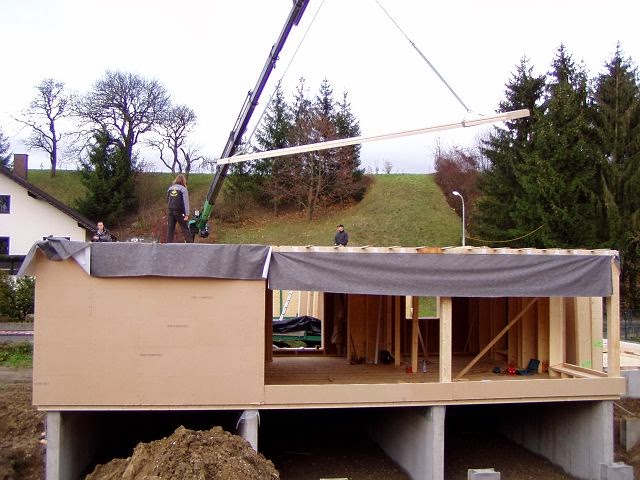
Our friend Josef's beautiful home is a great example of sustainable building techniques. Josef and his wife Petra have combined sustainable building with traditional, low impact practices to build their home in Austria.


Josef and Petra's beautiful home

The house is built from natural materials using a timber frame with a ready-to-coat outer face made of soft fibre timber plates.  The ceilings from the basement upwards are made of solid wood panels. This restricted the use of concrete solely to the construction of the basement.  


The open timber frame inside the house was filled with 36cm thick straw bales. Excellent insulation! The straw bales were made at Josef's brother's farm 2km away and collected by the family. You can't get much more sustainable than that!


Here are some shots of the straw bale walls going up.


The walls were then covered by oriented strand board, an engineered wood particle board. Parts of the interior were covered by a clay/sand render with reeds as a filler.


Due to the quality of construction and the insulation from the strawbales, the only heating required is a wood pellet heater using sustainably sourced wood pellets. The pellet heater also supplies hot water during winter. For the remainder of the year hot water is mainly from 10 m3 of solar collectors connected to a 1000 litre buffer storage tank. Rainwater collected on the roof is used for watering the garden.

In the garden, Josef has started building retaining walls using traditional dry stone wall techniques. 

the building materials

the finished wall


garden above the retaining wall

In the background of the above picture you can see Josef's mulching lawn mower.  When the grass is mowed this mulches the cut grass and leaves it on the ground. So the nutrients in the grass go back to the soil rather than being exported in a green waste bin. Josef says this mowing method has done a great job of building up the earthworm population ... and encouraging visits from blackbirds!

Isn't it a beautiful home?

As well as this write-up on our humble blog, Josef's house was also written up in a European Union publication "The Voices of Life: 20 years of getting things done".

It's wonderful to see so many great examples of pragmatic sustainability in one house. Josef, Petra and their children now have a comfortable home, made mostly from natural, sustainable materials with energy from renewable systems. Strawbale construction makes a lot of sense in Australia as well as Austria. Very good insulation for hot summers and drastically reduced heating requirements in winter. The large grain growing areas in Australia have millions of tonnes of straw after harvest. In Australia's mild climate a well-designed and built house needs very little heating. And the excellent insolation across much of Australia means that rooftop solar hot water systems can easily make much of the domestic hot water used. With rooftop photo-voltaics at $2/W it's cheaper to make electricity than buy it from the grid. Add some batteries - which are also dropping in price - and electricity from PV's can be stored for later use.

Tuesday, 7 May 2013

The Food Forest - a short photo tour

The Food Forest is a 15 hectare, certified organic permaculture farm and learning centre in Gawler, just 1 hour north of Adelaide. 

It is the result of the vision of its owners Graham and Annemarie Brookman who purchased the property in 1983 when it was essentially a bare paddock. It now hosts over 150 varieties of organically grown fruit and nuts, wheat and vegetables, honey and carob beans, as well as free range eggs, nursery plants and timber.

In addition to running a Permaculture Design Certificate (PDC) course each year, Graham and Annemarie also run a variety of short courses and host open days. It's a beautiful learning environment and the residential aspect of the PDC really allows you to immerse yourself in learning about sustainable living.

Here are a few photos taken around the property:

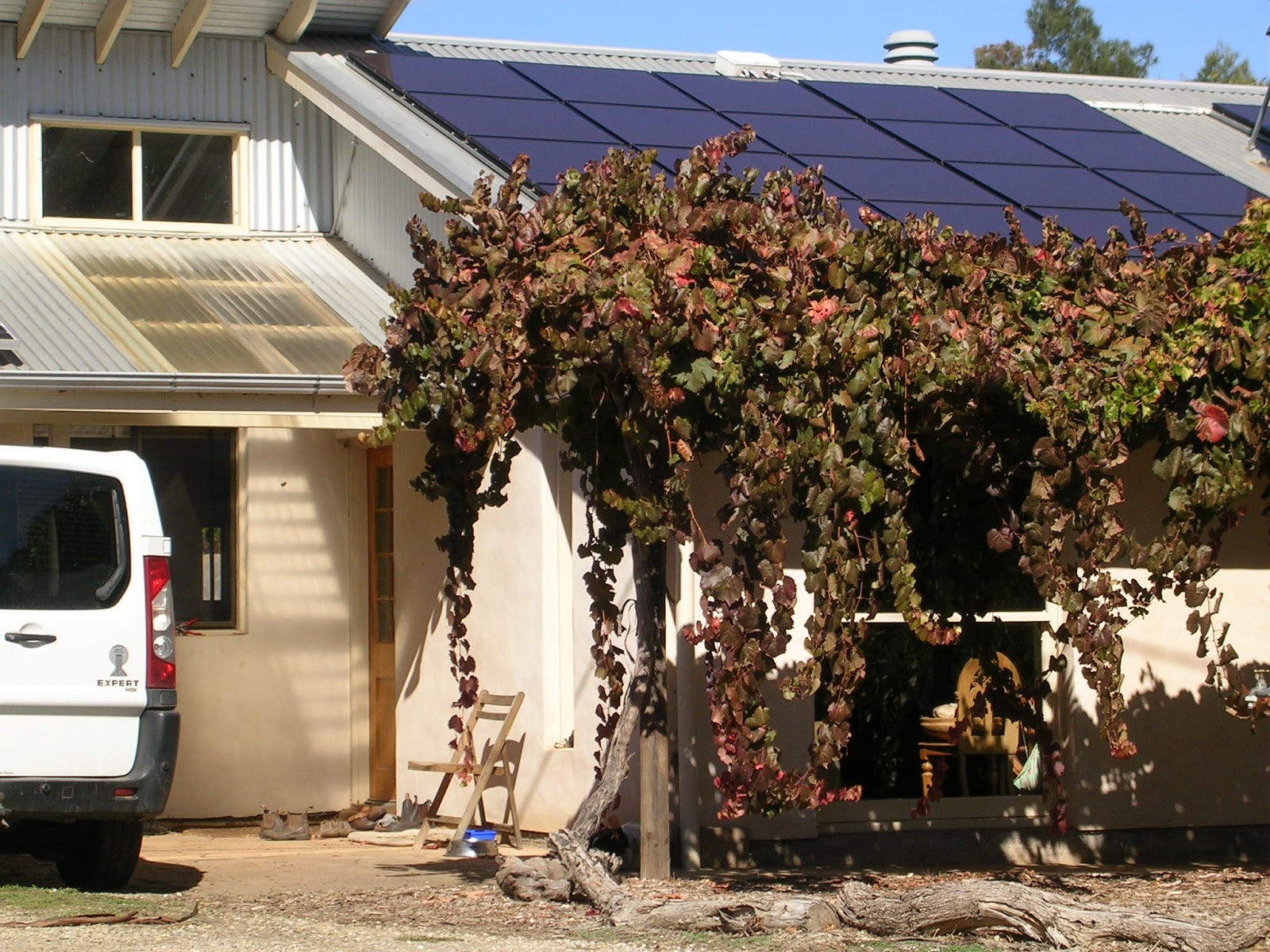
The heritage-listed homestead was built in the first few years of white settlement in South Australia. It has been extended using passive solar design with a combination of straw bale, stone and well insulated corrugated iron.

The original homestead


Under the verandah - original homestead


Strawbale extension to original homestead


Grapevine on pergola shades the strawbale extension

The old stone barn has been converted to a learning centre where the course lectures were presented, and a communal meals area.


Old barn - meals area


Old barn - indoor learning centre


In the learning centre - David Holmgren teaching

Just by the learning centre is the composting 'loo with a view'. It's a Clivus Multrum composting toilet and reedbed system which transforms human by-products into rich compost for fertiliser, as well as reeds for mulching and bamboo for furniture and structural work.

Composting toilets - loo with a view!

Behind the main house is a strawbale pergola with cob oven and herb garden - just perfect for plucking fresh herbs to put on your pizza before it slides into the oven.

Strawbale wall pergola with cob oven - in zone 1

Strawbale building techniques were also used to build the accommodation for those attending the course.

Strawbale accommodation

Even the farm's coolroom was made from strawbales.


The 'sand-pit' teaching area was a great way to demonstrate concepts such as keyline irrigation. And yes, it was made from strawbale too!


I can't finish this post without a photo of the food.  The meals were magnificent - all healthy, local and in-season food with a lot of the ingredients harvested directly from the Food Forest.


We're looking forward to returning to finish the course.