Showing posts with label firewood. Show all posts

Sunday, 9 August 2015

A sustainable property in Flowerdale

Last weekend we visited the sustainable property of Trent and Vikki who live in Flowerdale, roughly 60km north of Melbourne.  

Our visit was prompted by buying several hundred tree guards and stakes that Vikki and Trent had listed on ebay. When chatting to them on the phone beforehand to arrange pickup we discovered Trent and Vikki are committed environmentalists who live off-grid on a 70 acre property with solar-powered electricity, solar hot water and a composting toilet.  Needless to say we were looking forward to meeting them and seeing their property.

Trent is a full time environmental campaigner and Vikki is a nurse who strongly believes that one can't be a humanitarian without also being an environmentalist. Both are actively involved in campaigning to save the endangered Leadbeater's possum in the Central Highlands.

In 2009 the Black Saturday bushfires tore through Flowerdale. Fortunately, Trent and Vikki managed to save their home. A few months after the fires, they were married on the property.  On the wedding day, rather than bringing gifts, the wedding guests helped the bride and groom plant 2000 trees. Today those trees cover the hillside behind the house.

After a cup of tea and a nice chat by the fire, Trent and Vikki were kind enough to give us a tour of their property.  Trent built both the house and the barn himself, living in the barn loft while he built the house. Both buildings are clad with waste wood from a sawmill on the Murray River. But he didn't stop there - Trent even made the dining table and seating from sustainably sourced Ironbark. 
 
.


The barn hosts a PV installation


 And a building adjacent to the barn holds the battery bank that stores the captured energy.


Here's Trent and Vikki's son Jarrah showing us how it all works:


The family grows their own food, having a nice big vegie patch and an orchard. Chickens supply eggs and carry out pest control in the garden.


Waste wood was also used to make the post and rail fencing around the property:


After the tour they helped us pack up the tree guards and stakes. Here's what we came home with:


It was great to meet Trent and Vikki and see a couple putting into practice their values of trying to live sustainably and treading lightly on the earth. 

Thursday, 9 April 2015

Trees rock!

If tomorrow someone said they'd invented a self-reproducing tool for atmospheric carbon sequestration, improving water catchments, oxygen production, air filtering, low-carbon building materials, stock shelter, riparian zone protection, erosion management, food, bioenergy, firewood, biodiversity, habitat, paper manufacture, salinity control and recreation they'd be the Bill Gates of the 21st century. We don't have to wait for this invention as trees already exist!

At PragSust we think trees rock. We're developing an agroforestry or farm forestry site on our farm in Sth Gippsland with trees planted for multiple outcomes including many of the above. Ten years ago there wasn't a tree on the place except for some aging, exotic, remnant shelterbelts, a few paddock acacias and a few acacias on steeper slopes where the cows hadn't grazed as intensely. The previous owners planted some trees and we're planting a load more. We're particularly interested in durable timbers, fat logs for slabs and boards, high-value fine timber, roundwood construction using coppiced trees, bee fodder and craftwood for woodturners, garden use and rustic furniture. And we want to continue grazing cattle on the block.

Families owning woods for multiple outcomes is common in some of  the Scandinavian nations, parts of the US and Canada and increasingly in the UK. And farm forestry has become very popular in New Zealand. The length of time required to grow trees to a harvestable size is considerably less in Australia than in many parts of the northern hemisphere. It's quite realistic (in higher rainfall areas) with the correct site, species, outcome and management to start seeing some returns after ten years or so. Although a 20-40 year planning window does open things up a lot.

Some local landowners are also interested in these smaller-scale applications. So we thought we'd put together an initial checklist of some points to consider as part of planning trees on land. While written mainly for landholders this can also be useful in an urban setting. We've planted trees in our garden for bees and food but we do use prunings for other purposes.

Here's the list. Let us know what you think.

i/ What are the site characteristics? Soil, rainfall and temperature across the year, aspect, prevailing winds, slopes and contours.

ii/ What are your objectives? Construction timber? High value timber? Posts? Poles? Food? Onfarm use? Selling off-farm? Firewood? Bioenergy? Wattle structures? Rustic furniture? Bee fodder? Stock shelter and shade? Erosion management? Biodiversity? Habitat?

iii/ Do you want to have a go at practices like coppicing and hedge laying?

iv/ Timeframe. How soon do you want a return? Will you leave the property - and trees - for your children?

v/ How much area do you want to use for trees? Will you plant fence to fence, scattered in a paddock or in small coupes/woodlots?

vi/ Do you want to plant exotics, natives or a mix?

vii/ Do you want a monoculture plantation - some species occur naturally in largely single species stands - or to employ analogue forestry or another mixed species approach?

viii/ Budget. Will you grow some seedlings yourself? It's cheaper to raise trees from seed but it does require time and some skills. Specialist tree nurseries are good at growing trees and will save you time and effort.

ix/ Will you prune yourself? This will involve ladder work. Watching NZ videos of people pruning 12m high is sobering. Pruning for 6m clearwood logs is a common aim.

x/ How will you exclude stock and manage opportunistic browsers such as deer, wallabies and rabbits ?

xi/ Weed and fire fuel load management plan. Once stock are excluded grass and weeds will grow. Once the canopy closes in a densely planted coupe, grass and weeds will be suppressed but that will be some time down the track and may not occur for some weeds, such as blackberries, depending on the type of planting. Blackberries are a tough, successful plant that wants to grow in woodlands and forest edges. As well as rank grass and weeds, once the trees start dropping bark, dead branches, windthrow etc this is potentially a fire risk.

xii/ Will you harvest and thin yourself? This raises issues about safety and training in felling and chainsaw use. Forestry is about the most dangerous rural activity.

xiii/ Will you want to clear-fell - again well-suited to some species natural response to events like fire and cyclone - or use a technique like continuous cover forestry?

xiv/ How much time do you want to spend on forestry per annum?

xv/ What tools will you use? What do you own, what will you buy or hire and what will you get contractors to do? This will depend on whether you want to fell, buck and limb yourself or contract a harvester, use farm equipment to move logs or contractor trucks on farm tracks/roads (which will need to be a suitable standard for trucks to use), mill onsite or at a sawmill (which will require transport to the mill) and so on. Harvest is easier for  the farmer when done by external parties but there is less return to the grower. And for some sites it is prohibitively expensive to get contractor equipment to the coupe so the only option is smaller scale harvesting


Black cockatoos tucking into pine cones in a shelterbelt.

Cows in shelter on a warm summer day. These trees are under ten years old.

Monday, 5 January 2015

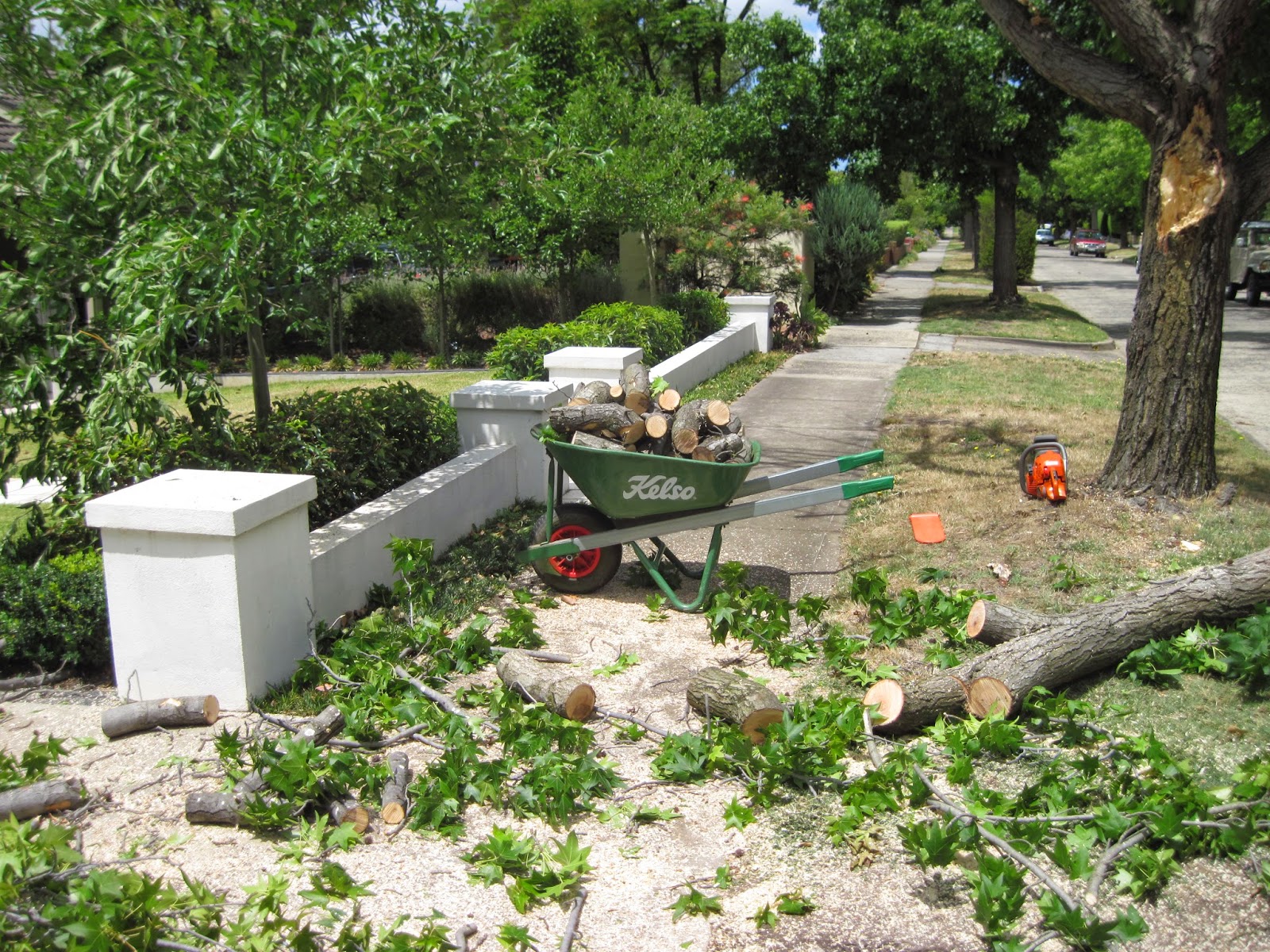
Very low firewood miles

We have a range of street trees planted in our neighbourhood. One common species is Liquid ambar (Liquidambar styraciflua). A large branch fell off one the other day not far from us.


Getting firewood usually involves putting wood in the back of the car wrapped in a tarpaulin or a trailer. With the prospect of low timber miles and using the wheelbarrow to bring the wood back I took the Huskie up the road.

First I trimmed small branches using the saw and breaking some off by hand. Taking off these small branches makes cutting up the larger limbs safer and easier. And the wood is easier to stack.


Then I cut up the branch into firewood sized pieces.


And loaded up the wheelbarrow.


To hold up the larger sections of the log which were lying on  the ground I used a log jack. Holding up the log end helps to avoid getting the chainsaw bar pinched and cutting into dirt. If the chain hits dirt while in use this blunts the cutters. Sharp chains are essential for safe and efficient use of a chainsaw. But not a job I want to do more often than necessary.


PragSust Enterprises owns a chainsaw mill. I considered slabbing the largest piece of  the branch but the wood had some rot.


Job done with wood cut into firewood lengths and the smaller material off the footpath and driveway. (If I'd had more time I could have chipped the smaller branches but I had some other work planned for that weekend including a trip to Emerald in the Dandenong Ranges to check out a largish Himalayan cedar Cedrus deodara for chainsaw milling.) The homeowner can put the smaller material in the green waste bin for collection. Our suburb has separate roadside collection for general waste, recycling and green waste.


I then stacked the wood under our north facing eaves. This spot is sheltered and captures a lot of sun. Wood dries quickly.


Firewood cognoscenti may notice an interesting mix of species. There's some blackwood (Acacia melanoxylon) from windthrow on a farm, some mountain ash (Eucalyptus regnans) from a large tree that blew over on a property in the Dandenongs, some pine (Pinus radiata) from farm tree fenceline trimmings and the just added liquid ambar.

The liquid ambar might not have long to live. Half of it looks dead.


And where the branch fell off doesn't look healthy. Perhaps pruning the tree into a wineglass shape to avoid contact between the electricity lines and the branches isn't so good for the tree. Burying the electricity lines might be a better solution.


Various parrot family members love the seeds from these trees. Corellas eat the seeds in the tree.


And on the ground.


As well as seeds from other trees.


As long as the wood is burnt when seasoned in a properly operated, high efficiency combustion system, wood energy is a low carbon, cost effective energy source. We get all of the wood we use for heating from what would otherwise be waste sources. And in this case we had very low firewood miles!